Seasonal event planning
How to Keep an Arizona HOA Party Calm When the Forecast Turns
Use this three-decision monsoon plan to choose a safe backup, time the weather call, and give residents one clear update before conditions change.
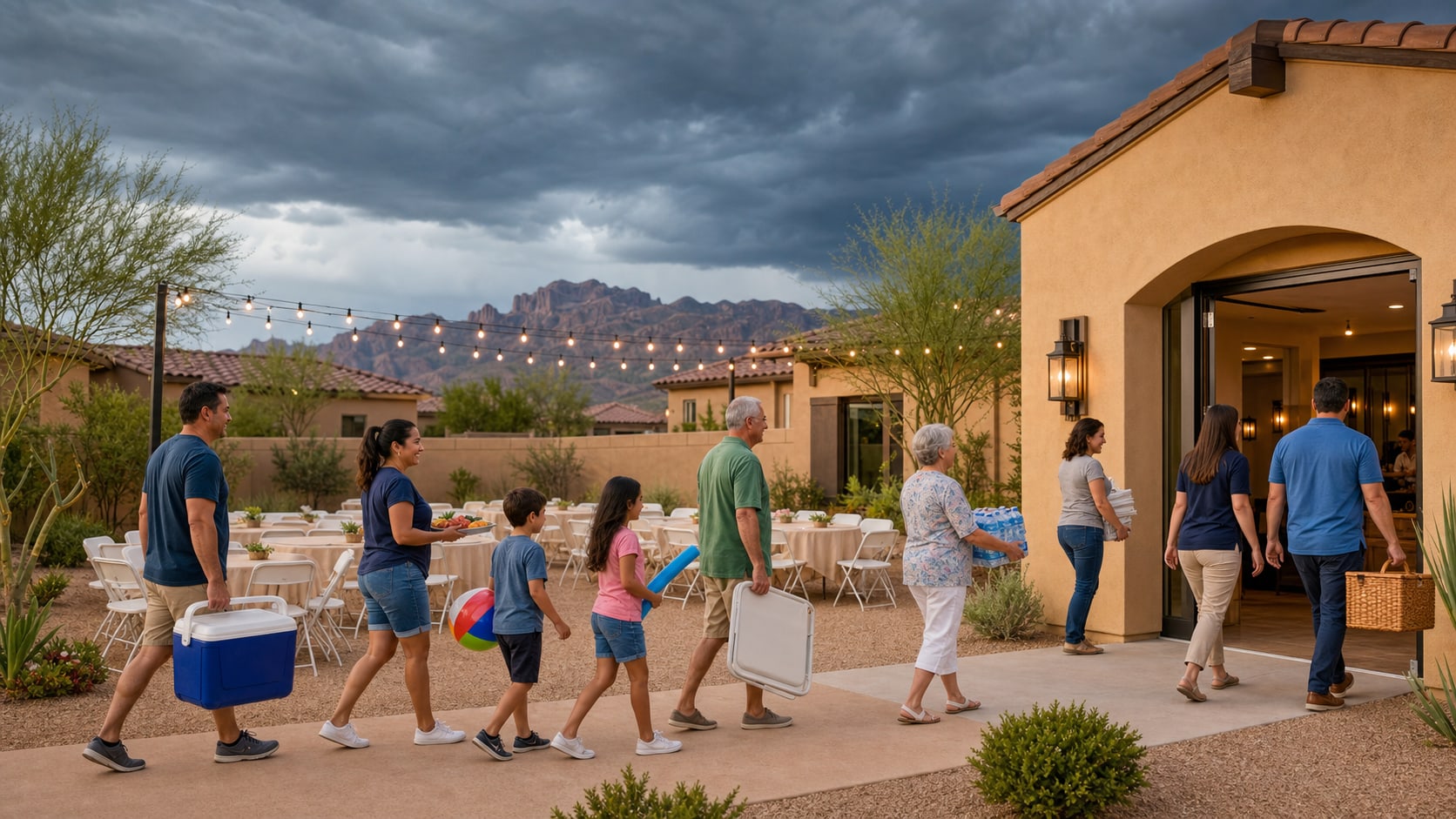
You know the moment. The tables are mapped, the food order is confirmed, and neighbors have finally started replying to the invitation. Then someone texts a screenshot of a thunderstorm icon and asks, "Are we canceling?"
Now five people are checking five weather apps. One person wants to move everything indoors. Another says Arizona storms always miss the neighborhood. Meanwhile, nobody knows who is actually making the call.
The best monsoon plan is not a perfect forecast. It is a short decision process everyone understands before the sky changes.
For an HOA block party, resident mixer, movie night, or community cookout, that process can be reduced to three decisions:
- Where will people go if the outdoor plan stops?
- Who makes the weather call, and when?
- How will guests, vendors, and volunteers hear the same message?
Build those answers early and a changing forecast becomes a manageable adjustment, not a committee emergency.
Safety note
This planning guide summarizes public safety guidance. It is not an emergency plan, medical guidance, or legal advice. Always follow current National Weather Service alerts, public safety instructions, venue rules, and provider requirements. Call 911 for an emergency.
Start With What Arizona Monsoon Season Actually Changes
The National Weather Service Phoenix office defines Arizona's monsoon season as June 15 through September 30. The season can bring thunderstorms, strong downburst winds, blowing dust, lightning, flash flooding, and heat.
That does not mean every summer event is unsafe or destined to be rained out. It means a clear outdoor Plan A needs a realistic shelter or relocation Plan B.
A shaded ramada, pop-up canopy, or tent may help with sun or rain, but it is not safe lightning shelter. The National Weather Service says safe shelter means a substantial enclosed building or an enclosed metal-topped vehicle with the windows up.
For an HOA event, identify the real shelter before invitations go out. Depending on the property, that could be a clubhouse, community room, recreation building, or enough enclosed vehicles for a small group. If your site has no suitable shelter for the expected attendance, choose a different location, time, or date.
If an indoor backup is the better answer, compare East Valley party and event venues before the last week. Confirm capacity, access time, parking, outside food and rental rules, and cancellation terms directly with the venue.
Decision 1: Build Plan B at the Same Time as Plan A
Most weather stress begins when Plan B is treated as something to invent later.
Your backup does not need to recreate the outdoor party. It only needs to preserve the reason people are gathering.
A useful Plan B answers five questions:
- Location: Where can the full guest count safely fit?
- Timing: Will the event move earlier, move later, shorten, or stay at the same time?
- Activities: Which activities can move indoors, and which will be removed?
- Food: Can the menu be served safely in the backup space?
- Access: Will parking, gates, restrooms, power, and accessibility still work?
For example, an outdoor resident movie night may not be able to move indoors with the same screen and seating plan. The backup could become a shorter community social with snacks, music, and a family game area inside the clubhouse. The experience changes, but neighbors still get the connection they came for.
Give every area a weather version
Walk through the outdoor layout and decide what happens to each zone:
- Guest seating moves, folds, or closes.
- Food moves inside or stays protected according to the caterer's guidance.
- Games pause and are stored according to the provider's instructions.
- Electrical equipment is shut down by the responsible operator.
- Decorations that could blow away come down early.
- The pool or splash area closes at the first sound of thunder.
Do not improvise anchoring, electrical protection, or wind limits. Follow the venue, rental provider, equipment manufacturer, and local authority instructions for the specific items on site.
Budget for the backup once
Plan B can affect food, room fees, staffing, cleanup, rentals, and deposits. Add the contingency before the committee approves the event, not after weather enters the forecast.
Use the free tool to build a realistic event budget around the guest count and event priorities. Then add any backup-space or weather-related costs that the calculator does not cover as separate planning lines.
A small contingency approved early is calmer than an emergency expense approved by group text.
Decision 2: Use Three Weather Checkpoints, Not Constant Polling
Weather apps update often. A committee can spend days reacting to every icon without making the event safer.
Instead, choose one weather lead and three checkpoints. This is a planning framework, not an official forecast rule. The event lead should still follow current warnings, venue policies, and emergency guidance.
Seven days before: confirm that both plans still work
At this stage, do not try to predict the exact event-hour weather. Confirm readiness:
- Is the backup space still available?
- Does it hold the expected attendance?
- Who can open it?
- Which vendors need advance notice before a change?
- Is there a cancellation or change deadline in any agreement?
- Does the guest message template have the correct phone number or email?
The goal is to remove logistical surprises while there is still time to solve them.
Forty-eight hours before: prepare the likely version
Review the official National Weather Service Phoenix forecast for the event location and any watches, warnings, or heat products. Contact the venue and vendors if the outdoor plan is becoming uncertain.
At this checkpoint, decide whether to:
- Keep Plan A active and stage Plan B.
- Move to Plan B before setup begins.
- Adjust the time or shorten the event.
- Postpone or cancel because a safe, workable event is no longer possible.
Avoid promising guests that the event is "rain or shine" unless you truly have a safe plan for every condition that phrase implies.
Two hours before: make one operational call
The designated weather lead reviews official alerts and current site conditions, then gives one instruction to the site lead, communications lead, and vendors.
The instruction should be specific:
- "Outdoor setup continues. Indoor room is unlocked and ready."
- "Move to the clubhouse plan now. Do not set up outdoors."
- "Event start moves to 6:30 p.m. Guests will receive the update by 4:15 p.m."
- "Event is postponed. Stop setup and send the postponement message."
One accountable decision is safer and kinder than a last-minute vote in several text threads.
Decision 3: Use Conditions That Trigger Action Immediately
Some conditions should not wait for the next committee checkpoint.
The National Weather Service Phoenix office advises postponing outdoor activities when a Severe Thunderstorm Warning has been issued. If thunder is heard, everyone should move immediately to a substantial building or an enclosed metal-topped vehicle.
If you can hear thunder, pause the event and move people indoors. Do not wait for rain.
Stay in safe shelter for at least 30 minutes after the last sound of thunder. A new rumble restarts that clock. Review the full National Weather Service lightning guidance while preparing the event plan.
Also act immediately when:
- Blowing dust is approaching the property or affecting travel visibility.
- Water is rising in a wash, roadway, parking area, or event path.
- Wind begins moving unsecured decor or equipment.
- A venue representative, public safety official, or equipment provider directs you to stop.
- A participant shows signs of a medical emergency.
Call 911 for an emergency. Do not ask volunteers to manage a condition beyond their training.
Protect the Trip Home, Not Just the Event Site
An HOA event can be dry while a dust storm or heavy rain affects the route guests are using.
The Arizona Department of Transportation says drivers should not enter a dust storm. If a driver is caught in blowing dust and cannot exit, ADOT's current Pull Aside, Stay Alive guidance explains how to leave the roadway safely and wait out the storm.
Do not send a message that pressures guests to hurry through bad conditions before the event starts. Give them permission to arrive late or stay home.
Use a line like this:
Weather may affect travel in parts of the East Valley. Please do not drive through blowing dust, flooded roads, or unsafe conditions to reach the event. Arrive only when your route is safe.
For flash flooding, the rule is simple: never drive around barricades or through a flooded roadway. Choose another route or wait.
Keep Heat in the Plan Even When Rain Is Possible
Clouds and a rain chance do not erase Arizona heat. Summer humidity can also make an evening feel harder than the temperature suggests.
A monsoon plan still needs shade, cold drinking water, an air-conditioned recovery area, and a shorter program.
Practical steps include:
- Place water where guests see it immediately.
- Give volunteers scheduled indoor breaks.
- Keep older adults, young children, pregnant guests, and anyone with health concerns close to the cooled area.
- Avoid a long opening program that keeps people standing outside.
- Tell guests in advance which parts of the event are outdoors.
- Know who will call 911 if someone becomes confused, collapses, or has another medical emergency.
Do not rely on a single volunteer to notice every guest. Make comfort visible and easy to choose. The Arizona Department of Health Services heat-safety resources provide additional current guidance.
Assign Four Roles Before Event Day
For a neighborhood event, four simple assignments prevent most communication gaps:
- Weather lead: Watches official forecasts and warnings, then makes the operational call.
- Site lead: Opens the backup location and directs setup, shutdown, or relocation.
- Communications lead: Sends one approved update to residents, volunteers, and vendors.
- Vendor contact: Confirms what each provider needs if timing or location changes.
One person can hold more than one role at a small event. The important part is that the names are written down and everyone knows who has final authority.
Copy-and-Paste Weather Messages for Residents
Plan B is ready
We are still planning to hold the neighborhood event at the scheduled time. We are monitoring the official forecast and have the clubhouse ready as our weather backup. We will send one final location update by [time].
Event is moving indoors
Tonight's neighborhood event is moving inside the clubhouse at [address or building name]. The start time remains [time]. Outdoor activities will be removed, but food and community activities will continue indoors. Please use [parking or entrance instructions].
Event is postponed
For guest and volunteer safety, tonight's outdoor event is postponed because of current weather conditions. Please do not travel to the site. We will share the new date and next steps by [day and time].
Event is paused for thunder
The event is temporarily paused because thunder has been heard near the site. Please move into the clubhouse or your enclosed vehicle now. We will remain sheltered for at least 30 minutes after the last thunder and will send another update before any outdoor activity resumes.
The One-Page Monsoon Event Checklist
Before invitations
- Identify a substantial enclosed backup shelter.
- Confirm capacity, access, restrooms, parking, and accessibility.
- Name the decision-maker and communication channel.
- Review venue and vendor change policies.
Seven days before
- Reconfirm Plan A and Plan B.
- Confirm guest count and volunteer roles.
- Draft all guest messages.
- Check food, decor, electrical, and activity changes.
Forty-eight hours before
- Review the official local forecast and alerts.
- Contact affected vendors.
- Prepare the likely layout.
- Decide when the final guest update will go out.
Two hours before
- Make one operational call.
- Unlock and prepare safe shelter.
- Brief volunteers and vendors.
- Send the guest update at the promised time.
During the event
- Move indoors immediately when thunder is heard.
- Stay sheltered 30 minutes after the last thunder.
- Stop outdoor activities under a Severe Thunderstorm Warning.
- Do not encourage travel through dust or flooded roads.
- Keep heat relief available.
A Calm Event Is the Real Plan
The goal is not to outguess an Arizona storm. It is to keep neighbors from standing outside while a committee debates what to do.
Choose the shelter, the decision-maker, and the message before event day. Everything else becomes easier.
If the event will use tables, chairs, games, or a movie setup, confirm the provider's weather, wind, relocation, and cancellation rules early. EventRent AZ serves Mesa and nearby East Valley communities, with availability varying by date, location, order size, and event needs.
Frequently Asked Questions
When is Arizona monsoon season?
The National Weather Service defines the official Arizona monsoon season as June 15 through September 30.
Is a ramada or pop-up tent safe during lightning?
No. The National Weather Service says there is no safe place outside during a thunderstorm. Move to a substantial enclosed building or an enclosed metal-topped vehicle with the windows up.
How long should an outdoor event wait after thunder?
Remain in safe shelter for at least 30 minutes after the last sound of thunder. If thunder is heard again, restart the 30-minute wait.
Who should decide whether an HOA event moves indoors?
Name one weather lead before event day. That person should review official alerts, current site conditions, venue requirements, and provider policies, then give one clear operational instruction to the team.
Plan the event before the forecast changes.
Build the guest count, event priorities, and weather contingency into one starting budget, then confirm current venue and provider policies before event day.
Open the Free Budget Calculator