Party planning
How Much Food Do You Need for a Party?
Use the five-part SERVE worksheet, a worked 40-guest example, and a final order checklist to turn guest count into a practical food plan.
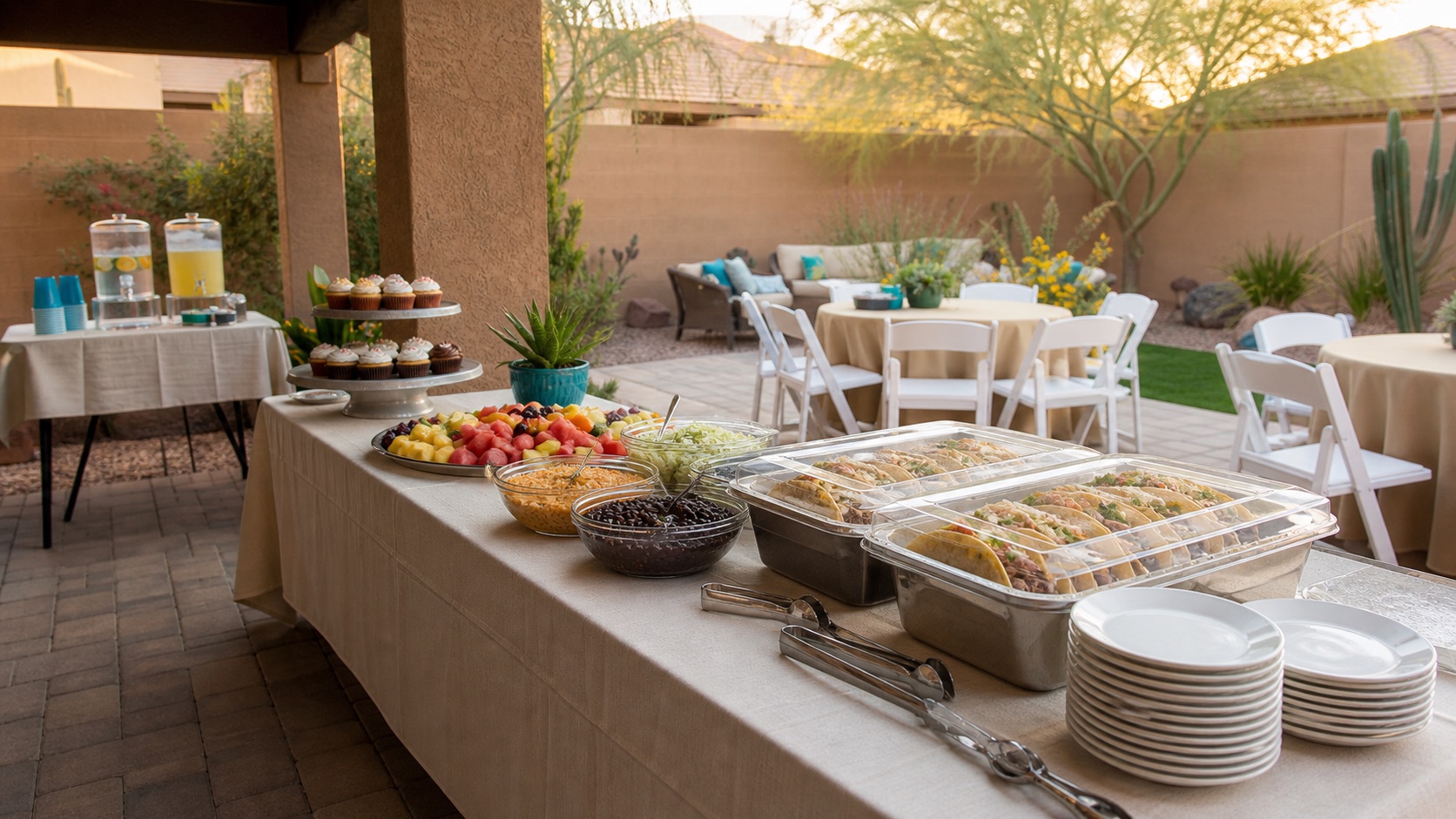
There is a specific kind of panic that arrives when the buffet looks small and the doorbell keeps ringing. The opposite is not much better: a refrigerator packed with untouched trays that cost more than the decorations.
The practical answer is to stop looking for one magic amount per person. Count the people likely to eat, decide what role the food plays, use the serving yield on the actual tray, package, or recipe, then add a small reserve only where it helps. That gives you an order you can explain, adjust, and afford.
Quick answer
For each menu item, use this formula: expected eaters × planned servings per eater ÷ servings per package or tray, rounded up. Choose the servings-per-eater assumption from the event schedule and menu, not from guest count alone. Confirm caterer yields before ordering and treat any reserve as a visible choice, not a hidden calculator setting.
EventRent AZ calls this the SERVE Party Food Worksheet: Schedule, Eaters, Role, Vendor or recipe yield, and Extras. It turns a nervous guess into five decisions you can check.
1. Choose the Menu's Job Before You Choose a Quantity
A tray of sliders behaves differently at a 2 p.m. open house than it does at a 6 p.m. birthday. Guests arrive with different expectations, and the same amount of food can feel generous at one event and obviously short at another.
Start by labeling the menu's role.
| Menu role | What guests are likely to expect | Best planning method |
|---|---|---|
| Full meal | Enough food to replace lunch or dinner | One main serving per eater, planned sides, and one dessert serving if dessert is offered |
| Appetizers as the meal | Several substantial bites over the full event | Ask the caterer for a duration-based per-person range, then confirm the number of pieces in each tray |
| Snacks before or after a meal | Something to nibble, not a replacement meal | Choose a few items, decide the number of pieces or servings each guest could reasonably take, and keep the reserve with the most popular item |
| Dessert or cake only | One clear sweet serving, plus an optional small alternative | Start with one serving per expected eater and round to the seller's actual package or cake yield |
| Open house with staggered arrivals | Food stays available across waves of guests | Estimate peak attendance, serve smaller batches, and keep replenishment cold or hot until needed |
Time of day is a promise. An invitation that spans lunch or dinner should either provide a meal or clearly tell guests what will be served. A vague menu creates more risk than a careful calculation can solve.
Do not automatically count every child as half an adult. A preschooler, a hungry teenager, and an adult do not eat the same way. If the menu is familiar, assign a realistic serving assumption to each guest group. If it is unfamiliar, keep a simple backup food that is easy to store and serve.
2. Use the EventRent AZ SERVE Party Food Worksheet
Write these five inputs before you shop or request a catering quote.
S: Schedule
Record the event start time, end time, and planned serving time. Mark whether the food replaces a meal and whether guests will arrive together or in waves.
A longer party does not automatically require a fixed multiplier. It may require a second serving window, more snacks, or a menu that holds safely. Decide which one applies.
E: Eaters
Count expected eaters, not invitations sent. Include hosts, children, vendors, photographers, or helpers who will eat. Keep uncertain guests in a separate line so you can see what their attendance would change.
A visible range is better than false precision. If you expect 36 to 40 people, calculate both ends. You may discover that both totals round to the same number of trays.
R: Role
Label each item as main, side, snack, dessert, condiment, or dietary alternative. This prevents the common mistake of calculating every item as though every guest will take a full portion of everything.
Two side dishes do not necessarily need 40 full servings each for 40 guests. Decide whether people are likely to take both, choose one, or take smaller amounts of each. Then write that assumption beside the item.
V: Vendor or Recipe Yield
Use the caterer's written tray yield, the package label, or a standardized quantity recipe. The University of Minnesota Extension guide to planning food quantities recommends standardized quantity recipes for groups of 25 or more and explains why simply multiplying a family recipe can fail.
Ask what "serves 10" means. Is that ten full portions, ten side portions, or ten sandwiches cut into twenty halves? If the answer is unclear, confirm before paying.
E: Extras
Choose the reserve last. A modest extra amount can help with late RSVPs or unexpectedly popular food, but adding the same percentage to every line creates expensive leftovers.
Put the reserve where it is useful: an extra pizza, a tray that can remain refrigerated, sealed snacks, or a shelf-stable backup. Do not create a large reserve of food that must sit outside to be useful.
3. Match the Quantity Method to the Food You Are Buying
Once the SERVE inputs are written, convert them into real purchase units.
For countable food:
expected eaters × pieces per eater = planned pieces
Then add any deliberate reserve and divide by pieces per package, pizza, or tray. Round up to a whole purchase unit.
For food sold by tray:
expected eaters × planned servings per eater ÷ stated servings per tray = trays needed
Round up, then confirm whether the tray yield assumes the item is a main or a side.
For a recipe:
servings needed ÷ recipe yield = batches needed
For a large group, use a quantity-tested recipe when possible. If you use a family recipe, making several normal batches can be more reliable than scaling one enormous batch, especially for baked or thickened foods.
For cake or dessert: use the bakery's cutting guide or package yield. "One sheet cake" is not a quantity until the seller tells you the size and serving count.
Before accepting any result, build one sample plate. Put the planned main, sides, and dessert on it. If the plate looks overloaded, your assumptions may be counting too many full portions. If it looks sparse for a meal, revise before multiplying.
4. Example: A 40-Guest Backyard Taco Bar
Suppose 40 people are expected for a 5:30 p.m. birthday. The taco bar is dinner. The host knows this group, chooses an editorial starting assumption of two tacos per eater, offers two sides, and wants a small reserve of tacos.
These numbers are an example of transparent planning, not universal consumption facts. The host should replace them with caterer guidance and knowledge of the guest mix.
| Item | Written assumption | Calculation | Purchase result |
|---|---|---|---|
| Tacos | 2 per eater, plus 10% taco reserve | 40 × 2 = 80; 80 × 1.10 = 88 | Order or prepare 88 tacos, rounded to the seller's package size |
| Rice | 0.75 side serving per eater; tray yields 12 side servings | 40 × 0.75 = 30; 30 ÷ 12 = 2.5 | 3 trays |
| Beans | 0.75 side serving per eater; tray yields 12 side servings | 40 × 0.75 = 30; 30 ÷ 12 = 2.5 | 3 trays |
| Dessert | 1 piece per eater, plus 2 pieces for uncertainty | 40 + 2 = 42 | 42 pieces, rounded to the bakery's package size |
Why not add 10 percent to everything? Rice, beans, and dessert already round up to whole purchase units. A second blanket buffer would hide inside those roundups and make the total less honest.
If ten guests are uncertain, run a second version for 50. Do not buy for 50 automatically. Ask the caterer when the final count is due and what can be added later.
Once you have real quotes, enter food, drinks and ice, rentals and seating, supplies, and contingency into the EventRent AZ party budget calculator. It lets you replace starting allocations with actual prices and see whether the plan still fits your ceiling.
5. In Arizona, Storage and Serving Capacity Limit the Menu
Buying enough food is only useful if you can store and serve it safely. Before approving a large order, count refrigerator shelves, coolers, ice capacity, outlets, warmers, serving utensils, and shaded staging space.
The FDA says cold foods should be held at 40°F or colder and hot foods at 140°F or warmer. Perishable food should not remain at room temperature for more than two hours, and that limit drops to one hour when the temperature is above 90°F. Review the FDA guidance for serving safe buffets before finalizing an outdoor Arizona serving plan.
Do not place the entire order on the table at once. Use smaller platters and replace them with properly held food. Keep backup cold dishes refrigerated or on ice, and verify that any warmer can actually hold the required temperature.
Put one person in charge of the food clock. That person should know when each perishable dish came out, where the backup is stored, and what should be discarded rather than saved.
If the venue handles food, ask what refrigeration, warming, prep, cleanup, and outside-catering rules are included. The EventRent AZ East Valley venue guide includes questions to confirm before booking, but the venue's current written policy controls.
6. Run This Final Order Checklist
Before you buy or sign the catering order, confirm:
- The expected eater count includes hosts and working guests who will eat.
- The invitation and menu agree about whether food replaces a meal.
- Each item has one role: main, side, snack, dessert, condiment, or dietary alternative.
- Every tray, package, cake, and recipe has a confirmed yield and serving definition.
- The order was rounded to real purchase units only once.
- Any reserve is visible, intentional, and concentrated in food that stores well.
- Guests had a reasonable way to share allergies or dietary needs.
- Dietary alternatives are enough for the people who need them and will not be accidentally taken first by everyone else.
- Refrigerator, cooler, warmer, table, and serving-utensil capacity match the order.
- One person owns replenishment, temperature checks, and the food clock.
- The food total has been added to the full event budget.
- The final guest-count deadline and add-on policy are confirmed with the caterer or seller.
If one line has no assumption beside it, it is still a guess. Fix that line before adding more food everywhere else.
Frequently Asked Questions About Party Food Quantities
How much food should I plan per person for a party?
There is no dependable universal total for every party. Decide whether the menu is a meal, appetizer-only menu, snack, or dessert. Then multiply expected eaters by a written serving assumption and convert the result using the actual package, tray, or recipe yield.
Should I add 10 percent extra food for a party?
A 10 percent reserve can be a useful choice for a popular main item or uncertain attendance, but it should not be automatic on every line. Whole-tray rounding may already create extra servings. Keep the reserve visible and favor food that can remain safely stored until needed.
How much food do I need for 50 guests?
Start with 50 expected eaters, then calculate each item separately. For example, a host who chooses two tacos per eater would start at 100 tacos before any deliberate reserve. Side and dessert totals depend on planned servings and the seller's stated yield. Confirm those assumptions with the caterer.
How do I keep buffet food safe at an outdoor Arizona party?
Hold cold food at 40°F or colder and hot food at 140°F or warmer. The FDA's normal two-hour limit for perishable food at room temperature drops to one hour above 90°F. Serve smaller batches, keep backup food properly held, and assign someone to track time and temperature.
A Better Food Plan Is One You Can Explain
You do not need a perfect prediction of every appetite. You need a plan that shows who is eating, what the menu promises, how many servings the seller provides, and where the reserve lives.
Use the SERVE worksheet, calculate in real purchase units, and check storage before checkout. You will spend with more confidence, make smarter last-minute changes, and give guests enough to enjoy without turning leftovers into the biggest part of the party.
Plan the full event
Put the food estimate into your complete budget.
Use the free EventRent AZ calculator to compare food, drinks, rentals, supplies, and contingency without an email gate.
Open Budget Calculator